Risks and problems this service helps prevent
Chloride contamination can remain hidden while corrosion develops around embedded reinforcement. As steel corrodes it expands, creating internal pressure that can crack and delaminate the surrounding concrete. By the time rust staining or spalling becomes visible, deterioration may already be well established.
Without reliable test data, repairs may treat only the visible damage while leaving chloride-contaminated concrete in place. This can shorten the life of repairs, increase future maintenance costs and make it difficult for engineers to define an appropriate remediation boundary.
Chloride testing helps quantify contamination at selected locations and depths so engineers and asset owners can assess corrosion risk and plan further investigation or repair. Sampling is localised, so results must be interpreted alongside exposure conditions, reinforcement cover, carbonation, moisture, corrosion surveys and structural observations where relevant.
What can be detected or assessed?
- Chloride concentration in collected concrete samples
- Changes in chloride content with depth from the exposed surface
- Areas with elevated contamination relative to other locations
- Potential reinforcement corrosion risk when interpreted against project criteria
- The extent of salt exposure in marine, coastal or industrial environments
- Locations that may require further durability or corrosion investigation
Typical projects and industries
- Marine structures, jetties and coastal assets
- Car parks, bridges and transport infrastructure
- Industrial plants and process areas
- Existing-building condition assessments
- Concrete repair and remediation planning
- Mining, water and regional infrastructure assets
How the process works
- The investigation objective, sampling locations, required depths and reporting criteria are agreed with the client or engineer.
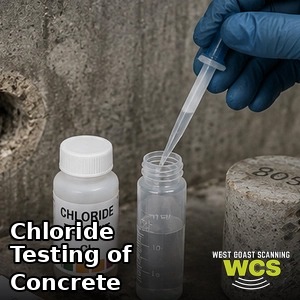
- Concrete powder or core samples are collected using an appropriate controlled method and labelled to preserve location and depth information.
- Samples are tested using the agreed field or laboratory procedure for chloride content.
- Results are reviewed against the specified project criteria, relevant standards or engineering requirements.
- A clear record of sampling locations, depths, results and limitations is supplied.
What the customer receives
- A record of sample locations and collection depths
- Chloride test results for each submitted sample
- Photographs of sampling locations where included
- A tabulated summary suitable for engineering review
- A written report or laboratory documentation where included in the agreed scope
Why West Coast Scanning is well positioned to help
West Coast Scanning offers a practical, responsive approach to concrete investigation, backed by more than 12 years of industry experience. Chris works directly with engineers, contractors, facility managers and asset owners, helping coordinate sampling and site access without the delays that can come with a large multi-layered provider.
Our family-run business provides free quotes, competitive rates and flexible scheduling throughout Perth and regional WA. We are known for fast communication, personal attention and prompt results and invoicing where the testing process allows. Chloride testing can also be coordinated with concrete scanning and other site investigations, giving clients a more efficient single point of contact.
Frequently asked questions
Why are chlorides harmful to reinforced concrete?
Sufficient chloride concentration at the reinforcement can break down the steel’s protective passive layer and allow corrosion to begin when moisture and oxygen are present.
Is chloride testing destructive?
It is minimally intrusive rather than fully non-destructive. Small powder samples or cores must be collected from selected locations, and the holes can be repaired afterwards.
How many samples are needed?
The number depends on structure size, exposure, visible deterioration and the engineering objective. Samples are often collected at multiple locations and depths to understand the chloride profile.
Can the test tell whether the reinforcement is already corroding?
Chloride results indicate contamination and corrosion risk, but they do not by themselves confirm active corrosion. Additional testing such as half-cell potential, resistivity, cover measurement or visual investigation may be required.
Do you provide laboratory testing?
The testing and reporting pathway should be confirmed in the quote. Where laboratory analysis is required, sampling and documentation can be coordinated to suit the project specification.